




How does a railway tamper ensure the track's stability during train passage?
 Jan 20, 2026|
 Alright, folks! As a supplier of railway tampers, I'm super excited to dive into how these nifty machines ensure the track's stability during train passage. It's a topic that's close to my heart because, let me tell you, a stable track is the backbone of a smooth and safe train journey.
First off, let's talk about what a railway tamper actually is. In simple terms, it's a machine designed to pack the ballast under the railway tracks. Ballast is that layer of crushed stones or gravel that sits beneath the sleepers (or ties, if you're in the US). It's not just there for decoration; it serves a crucial purpose. The ballast provides support for the tracks, distributes the load of the trains, and allows for proper drainage.
So, how does the tamper play its part in all this? Well, as trains roll over the tracks, they exert a huge amount of force. This force can cause the sleepers to shift and the ballast to become loose. If left unchecked, this can lead to uneven track surfaces, which are not only uncomfortable for passengers but also extremely dangerous. That's where the railway tamper steps in.
One of the key ways a tamper ensures track stability is by tamping the ballast. Tamping involves inserting the tamping tools (usually a set of vibrating tines) into the ballast on either side of the sleepers. The tines vibrate at a high frequency, which causes the ballast particles to rearrange themselves and pack tightly around the sleepers. This creates a solid foundation for the tracks, preventing the sleepers from moving and keeping the tracks level.
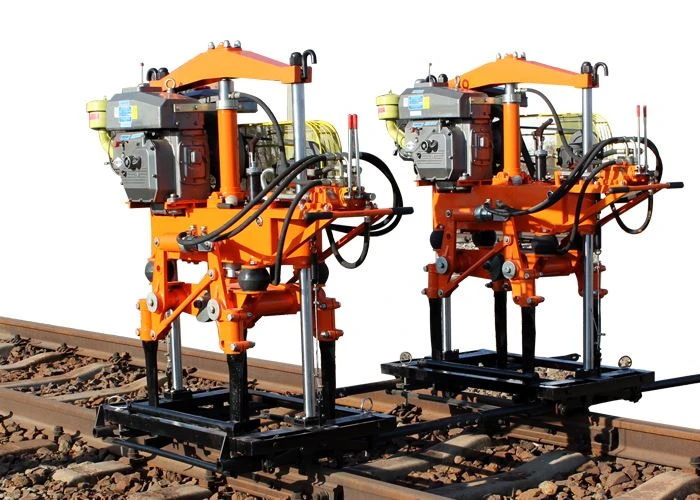
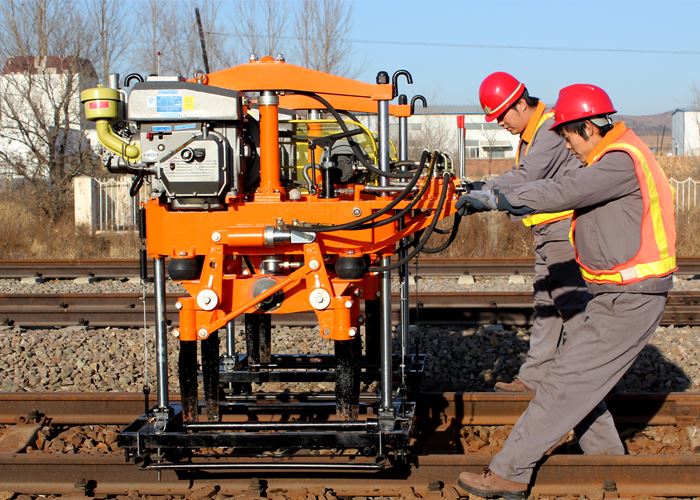
Let me give you an example of one of our top - selling products, the Diesel Hydraulic Rail Tamping Machine. This machine is a real workhorse. It uses a diesel - powered hydraulic system to drive the tamping tools. The hydraulic system provides precise control over the tamping operation, allowing the operator to adjust the depth and force of the tamping according to the condition of the ballast and the requirements of the track.
The vibration frequency of the tamping tools is also a crucial factor. Different types of ballast and track conditions require different vibration frequencies. Our machines are designed to be adjustable, so the operator can set the optimal frequency for the job. For example, if the ballast is coarse and loose, a higher vibration frequency might be needed to get the particles to pack tightly. On the other hand, if the ballast is finer or already somewhat compacted, a lower frequency could be sufficient.
Another important aspect is the alignment of the tracks. A railway tamper can also help with this. Some of our advanced models, like the YD - 22 Hydraulic Rail Tamping Machine, are equipped with alignment systems. These systems use sensors to detect any misalignment of the tracks and adjust the tamping operation accordingly. By ensuring that the tracks are properly aligned, the train can run smoothly and safely, reducing wear and tear on both the train and the tracks.
Now, let's talk about switches. Switches are those parts of the track where the train can change from one line to another. They are more complex and require special attention. That's where the YCD - 32 High Efficient Hydraulic Switch Tamping Machine with Petrol Engine comes in. It's specifically designed to handle the unique requirements of switch tamping. The machine can access the tight spaces around the switch components and tamp the ballast effectively, ensuring that the switch remains stable and functional.
Regular maintenance of the tracks using railway tampers is essential. Trains run day in and day out, and the constant stress on the tracks takes a toll. By tamping the ballast regularly, we can prevent small issues from turning into big problems. For instance, if a small section of the track starts to become uneven due to loose ballast, a timely tamping operation can fix it before it causes derailment or other serious accidents.
In addition to tamping, modern railway tampers also have other features that contribute to track stability. Some machines are equipped with leveling systems that can adjust the height of the tracks. This is important because even a slight difference in track height can cause problems for the trains. The leveling system uses sensors to measure the height of the tracks and then makes the necessary adjustments during the tamping process.
The speed of the tamping operation is also a consideration. We want to get the job done quickly, but not at the expense of quality. Our machines are designed to be efficient, allowing them to cover a large section of the track in a relatively short time. However, the operator still has to pay close attention to the details to ensure that each tamping operation is done correctly.
So, there you have it, folks! That's how a railway tamper ensures the track's stability during train passage. It's a combination of proper tamping, alignment, and regular maintenance. Our range of railway tampers, from the Diesel Hydraulic Rail Tamping Machine to the YCD - 32 High Efficient Hydraulic Switch Tamping Machine with Petrol Engine, is designed to meet the diverse needs of the railway industry.
If you're in the market for a reliable railway tamper, we're here to help. Whether you need a machine for a small - scale operation or a large - scale railway network, we've got you covered. Reach out to us for more information and let's start a conversation about how our products can make your track maintenance easier and more effective.
References
- Railway Engineering Handbook.
- Technical manuals of our railway tamper products.