




What is the mathematical structure of a rail tensor?
 May 19, 2025|
 What is the mathematical structure of a rail tensor?
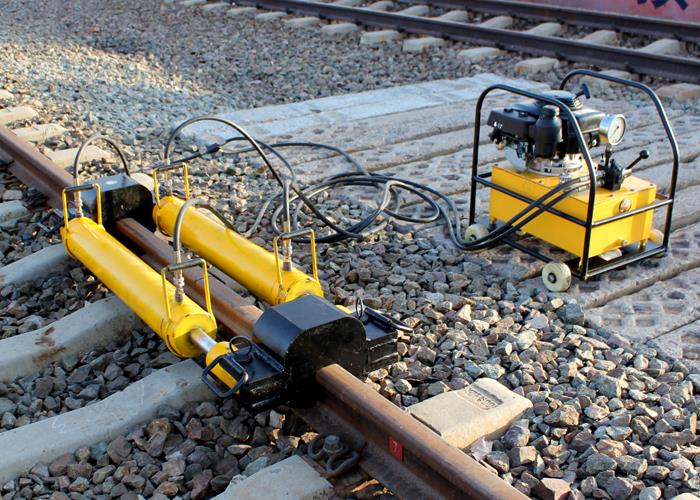
As a supplier of rail tensors, I've often been asked about the mathematical structure behind these essential pieces of equipment. Rail tensors, also known as rail stressing equipment, are crucial for maintaining the integrity and safety of railway tracks. They are used to stretch rails to the correct stress level, ensuring proper alignment and preventing issues such as buckling or excessive wear.
Basic Mathematical Concepts
To understand the mathematical structure of a rail tensor, we first need to grasp some fundamental concepts in mechanics and materials science. At the heart of the matter is the relationship between force, stress, and strain.

Force (F): This is the external influence that causes an object to change its state of motion or deformation. In the context of a rail tensor, the force is applied to stretch the rail. The unit of force in the International System of Units (SI) is the Newton (N).
Stress (σ): Stress is defined as the force applied per unit area. It is calculated using the formula σ = F/A, where F is the force applied and A is the cross - sectional area of the rail. Stress has units of Pascals (Pa), where 1 Pa = 1 N/m².
Strain (ε): Strain measures the relative deformation of an object. For a rail being stretched, it is the ratio of the change in length (ΔL) to the original length (L₀) of the rail, i.e., ε = ΔL/L₀. Strain is a dimensionless quantity.
The relationship between stress and strain is described by Hooke's Law for elastic materials within the elastic limit. Hooke's Law states that σ = Eε, where E is the Young's modulus of the material. The Young's modulus is a measure of the stiffness of the material and has units of Pa.
Mathematical Model of a Rail Tensor
Let's consider a simplified mathematical model of a rail tensor in action. Suppose we have a rail tensor that applies a force F to a rail of cross - sectional area A and original length L₀.
The stress induced in the rail is given by σ = F/A. According to Hooke's Law, the strain ε in the rail is ε = σ/E = F/(AE). And the change in length of the rail ΔL can be calculated using the strain formula ε = ΔL/L₀, so ΔL = εL₀ = (F/(AE))L₀.
In a real - world scenario, the force applied by the rail tensor is not constant throughout the stretching process. The rail tensor needs to overcome the initial resistance of the rail, and as the rail stretches, the force required to continue stretching increases due to the increase in stress.
We can also consider the work done by the rail tensor in stretching the rail. The work done W is equal to the integral of the force with respect to the displacement. If we assume a linear relationship between force and displacement (which is a reasonable approximation within the elastic limit), the work done is W = 1/2 FΔL.
Practical Considerations
When designing and using a rail tensor, several practical factors need to be considered in addition to the basic mathematical model.
Friction: There is friction between the rail tensor and the rail, as well as within the components of the rail tensor itself. This friction affects the efficiency of the force transfer and needs to be accounted for in the design. The frictional force Ff can be estimated using the formula Ff = μN, where μ is the coefficient of friction and N is the normal force.
Material Properties: The Young's modulus E and the yield strength of the rail material can vary depending on the type of steel used in the rail. Different rails may require different forces to achieve the desired stress and strain levels.
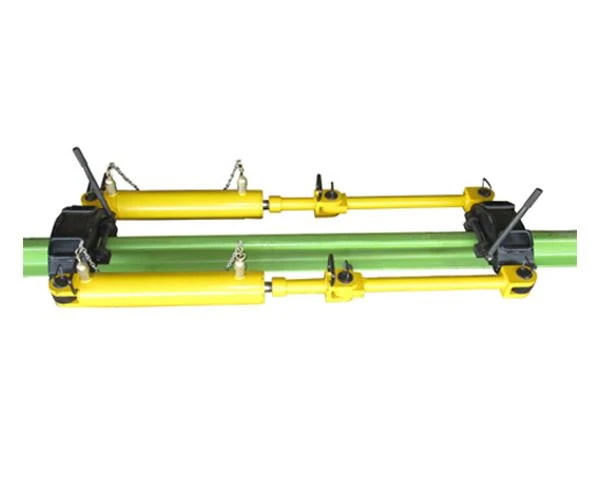
Safety Factors: To ensure the safe operation of the rail tensor, safety factors are incorporated into the design. For example, the maximum force that the rail tensor can apply is usually set well below the force that would cause the rail to yield or the rail tensor to fail.
Our Rail Tensor Products
We offer a range of high - quality rail tensors, including the [YLS - 900 Hydraulic Rail Tensor](/rail - stretching - and - rail - gap - adjusting - series/yls - 900 - hydraulic - rail - tensor.html), [Rail Tensor (Rail Stressing Equipment Rail Puller Rail Stressor)](/rail - stretching - and - rail - gap - adjusting - series/railway - maintenance - tools - rail - tensor.html), and [YLS 900I Hydraulic Rail Tensor](/rail - stretching - and - rail - gap - adjusting - series/yls - 900 - i - factory - wholesale - hydraulic - rail.html). These products are designed with precision engineering and incorporate the latest advancements in hydraulic technology to provide reliable and efficient rail stretching solutions.
Each of our rail tensors is carefully calibrated to apply the correct amount of force based on the specific requirements of the rail. Our engineers use advanced mathematical models and simulations to optimize the design and performance of our products, taking into account factors such as material properties, friction, and safety.
Contact Us for Purchase and Consultation
If you are in the market for a rail tensor or need more information about the mathematical structure and performance of our products, we encourage you to contact us. Our team of experts is ready to assist you in selecting the right rail tensor for your specific needs and can provide detailed technical support and guidance. Whether you are a railway maintenance company, a construction firm, or an infrastructure developer, we have the solution for you.
References
- Gere, J. M., & Timoshenko, S. P. (1997). Mechanics of Materials. PWS Publishing.
- Calladine, C. R. (2000). Engineering Plasticity. Cambridge University Press.