




What is the turning ability of a rail vehicle?
 May 21, 2025|
 Hey there! As a supplier of rail vehicles, I often get asked about the turning ability of these cool machines. It's a super important aspect, especially when you're looking at the efficiency and safety of rail transportation. So, let's dive right in and explore what the turning ability of a rail vehicle really means.
First off, what do we mean by "turning ability"? Well, it's all about how well a rail vehicle can navigate curves on the tracks. You see, rail tracks aren't always straight. There are bends, curves, and sometimes really tight corners that a train or any other rail vehicle has to go through. The turning ability determines how smoothly and safely it can make these turns.

One of the key factors that affects the turning ability is the wheel - rail interface. The wheels of a rail vehicle are designed in a specific way. They have a conical shape, which helps in negotiating curves. When a train enters a curve, the outer wheel on the curve has to travel a longer distance than the inner wheel. The conical shape of the wheels allows them to adjust their effective rolling radius. The outer wheel rolls on a larger diameter part of the cone, while the inner wheel rolls on a smaller diameter part. This difference in rolling radii helps the vehicle to turn smoothly without slipping or derailing.
Another important aspect is the wheelbase. The wheelbase is the distance between the centers of the front and rear axles of a rail vehicle. A shorter wheelbase generally means better turning ability. Vehicles with a shorter wheelbase can more easily follow the curvature of the track. For example, a small 500kg insulated alloy Rail Trolley By Manual has a relatively short wheelbase, which allows it to make sharp turns on narrow - gauge tracks. On the other hand, a long - haul freight train with a large number of cars and a long wheelbase may have more difficulty navigating tight curves.
The design of the bogies also plays a crucial role. Bogies are the wheeled frames under the rail vehicle that support the carbody. They are designed to pivot, which helps the vehicle to follow the track's curvature. Modern bogies are equipped with advanced suspension systems and steering mechanisms that enhance the turning ability. For instance, some high - speed trains have self - steering bogies that can automatically adjust the position of the wheels to optimize the turning performance.
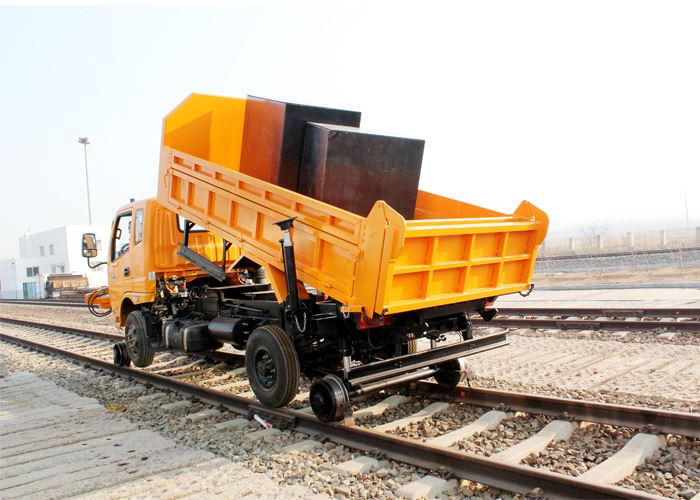
Now, let's talk about different types of rail vehicles and their turning abilities. Road Rail Vehicles Road Rail Vehicles are quite unique. These vehicles can operate both on roads and rails. Their turning ability on rails is a bit different from traditional rail - only vehicles. Since they are also designed for road use, they need to be more maneuverable. They usually have a relatively short wheelbase and a well - designed steering system that allows them to make sharp turns on rails as well as on roads.
Battery - powered rail cars, like the DPC - 4 Battery Track Car, also have their own characteristics when it comes to turning. These cars are often used for short - distance transportation, such as in industrial yards or on light - rail systems. Their smaller size and electric drivetrains give them an advantage in terms of turning ability. They can quickly change direction and navigate through tight spaces.
The track gauge also has a significant impact on the turning ability. There are different track gauges around the world, such as standard gauge, narrow gauge, and broad gauge. Narrow - gauge tracks have a smaller distance between the rails, which allows for sharper curves. Rail vehicles designed for narrow - gauge tracks are usually smaller and more maneuverable. In contrast, broad - gauge tracks are used for heavy - haul trains and high - speed trains. These tracks generally have gentler curves, and the vehicles operating on them are designed to handle the larger forces involved in turning at higher speeds.
Safety is a major concern when it comes to the turning ability of rail vehicles. If a vehicle cannot turn properly, it can lead to derailment, which is extremely dangerous. That's why strict safety standards are in place for rail vehicle design. Engineers have to conduct extensive testing to ensure that the turning ability meets the required safety levels. This includes testing the vehicle's performance on different types of curves, at various speeds, and under different environmental conditions.
In addition to safety, the turning ability also affects the operational efficiency of rail transportation. A vehicle that can turn smoothly and quickly can reduce travel time and increase the frequency of service. For example, in a subway system, trains with good turning ability can operate more efficiently, allowing for more frequent arrivals and departures at stations.
As a rail vehicle supplier, we understand the importance of turning ability. We work hard to design and manufacture vehicles that offer excellent turning performance. We use the latest technologies and materials to optimize the wheel - rail interface, bogie design, and overall vehicle geometry. Our goal is to provide our customers with rail vehicles that are not only safe but also highly efficient.
If you're in the market for rail vehicles, whether it's a small trolley for an industrial site or a large - scale passenger train, the turning ability is something you should definitely consider. It can have a big impact on the performance and cost - effectiveness of your rail transportation system.
So, if you're interested in learning more about our rail vehicles and their turning abilities, or if you want to discuss your specific requirements for a rail project, don't hesitate to get in touch with us. We're always here to help you find the best solution for your needs. Let's start a conversation and see how we can work together to make your rail transportation dreams a reality.
References
- "Rail Vehicle Dynamics: A Comprehensive Introduction" by John D. Fenton
- "Fundamentals of Railway Engineering" by Mark W. Smith