





Analysis of the causes of aluminium heat welding defects in steel rails and preventive measures
 May 09, 2025|
 1. Shrinkage and loose loose inner surface is not smooth, generally easy to occur in the centre of the weld at the rail waist and bottom of the central triangle, as shown in Figure 1.
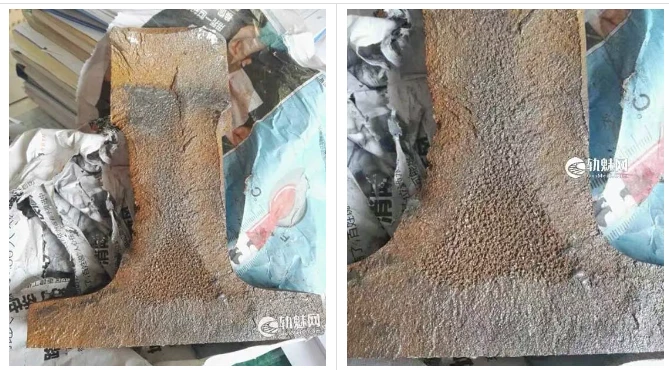
1.1 The main reason for the formation of such defects is the local temperature is too high, the cooling time is not the same. In the aluminium heat welding process: preheating time is too long or preheating pressure adjustment is not correct; local high temperature, overheating phenomenon, especially the rail waist and rail bottom part of the local overheating phenomenon; preheating gun or sand mold installed bias, position is not centered, the formation of one side of the phenomenon of overheating; rail seam is too large.
1.2 Preventive measures
(1) preheating time is appropriate, shall not be the end of the rail burned.
(2) Preheater flame length is moderate.
(3) The preheater is placed in the centre of the rail seam.
(4) The rail seam is moderate. 2 pores is the steel in the reaction process of the release of gas, solidification is not timely discharged from the mouth, left in the weld sub-surface and the internal round hole. Pneumatic holes are the most common defects in aluminium heat welding, generally easy to produce in the bottom of the rail and the bottom of the rail on both sides of the sloping surface, its surface is smooth, generally round (Figure 2).

1.1 Causes of formation
(1) The end face of the rail to be welded is not thoroughly cleaned, with water or oil stains.
(2) The flux is damp.
(3) Dampness of sand mould.
(4) Sealing mud is too much and too wet.
(5) Preheating temperature is too low.
(6) The operation time from the end of preheating to the pouring is too long, so that the temperature after preheating is lowered more.
2.2 Preventive Measures
(1) Thoroughly clean both end surfaces of the rails to be welded.
(2) Strictly prevent the welding material from moisture.
(3) The sealing mud shall not be too wet, and it is not easy to apply too much.
(4) The preheating temperature of the rails should reach 800~900℃.
(5) Pour the flux into the crucible in advance, prepare high-temperature matches, and immediately place the crucible after preheating, ignite and pour. Secondary preheating; shunt plug placement.
3 Slag entrapment is a low-fold inclusions defect that exists on the surface or inside the aluminium heat welding weld. In the casting process, such as part of the molten slag in the steel water is not timely upward flow away, and in the welding bar is solidified inside or attached to the surface of the welding bar, then the formation of slag-type inclusions, usually referred to as slag (Figure 3).
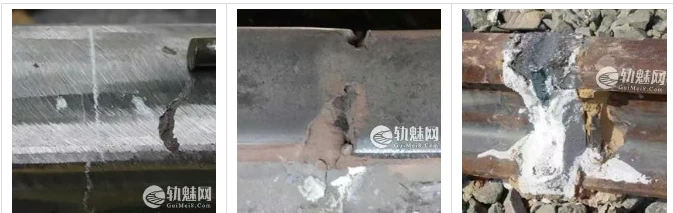
3.1 Formation reasons
(1) when the clamp pot for aluminium heat reaction, slag from the clamp pot out into the cavity, adhering to the surface of the rail, when the steel into the cavity can not be part of the slag flushed away floating and the formation of slag;
(2) not enough time to calm, the reaction is not completed on the casting (eg, Konyi hit the nail too early or automatic de-selection, etc.), slag is not sufficiently separated from the liquid steel, so that the slag not completely floating, oxide skin and inclusions into the weld;
(3) the rail seam is too large, not enough steel or bottom cast 'running iron', so that the slag into the cavity. Skin and inclusions into the weld;
(4) rail gap is too large, not enough steel or the bottom of the rail casting 'running iron', etc., so that the slag into the cavity.
3.2 Preventive measures
(1) thoroughly clean the two end surfaces of the rails to be welded.
(2) rail seam moderate.
(3) carefully check the crucible for damage before use, and be sure to place the crucible with the pouring port in the centre above the sand pattern.
4 sand trap Sand trap is also a low-fold inclusions defect on the surface or inside the aluminium heat welding weld. In the pouring condensation process, the local snail, sand moulds and other refractory materials are burned, or shedding debris, floating sand into the molten steel is solidified, the formation of sand (Figure 4).
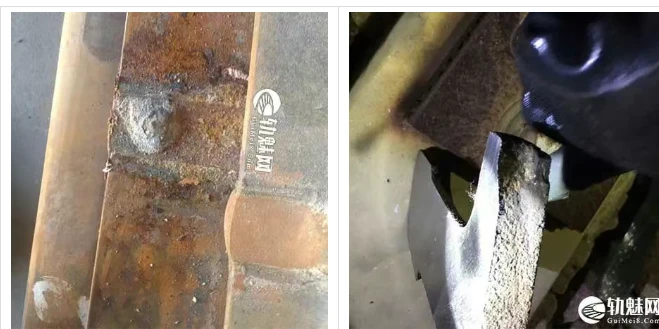
4.1 Causes of formation
(1) Floating sand produced is not thoroughly removed after sand grinding.
(2) There are impurities into the cavity.
(3) The sand type is not fastened correctly at one time, and the sand type is squeezed out and falls into the cavity during the movement.
(4) Excessive preheating, burned sand.
4.2 Preventive measures
(1) Thoroughly clean the floating sand in the cavity after sand grinding.
(2) During the operation, it is strictly prohibited to drop foreign objects into the cavity.
(3) If there is any misalignment after the sand box is closed, the sand must be reopened to clean up the inside of the cavity.
5 Thermal Cracking Aluminium thermal welding weld at the casting tissue in the high temperature before solidification of the tensile stress effect of the formation of cracks, that is, thermal cracking. Thermal cracks are usually located in the weld size of the weld bar in the middle, along the transverse direction of development, the fracture has a bluish oxidation colour or temperature colour, as shown in (Figure 5).

5.1 Causes of formation
(1) There is movement of the weld during the welding process, which is subject to tension or the presence of large tensile stresses.
(2) Premature unboxing, so that the weld head is stressed in advance.
(3) Push the tumour in advance, so that the weld head is stressed in advance.
(4) Welding head in the cooling process, not fully solidified by external hammering.
(5) Welding head in the cooling process, not fully solidified when the rail contraction.
5.2 Preventive measures
(1) in the entire welding process is strictly prohibited to step on, knocking, prying the rail to be welded.
(2) Carry out the dismantling and tumour pushing operation according to the time required by the process.
(3) It is forbidden to dismantle the rail pairing equipment too early.
(4) rail with the temperature contraction is large, take measures to maintain the size of the rail gap.6 not welded rails aluminium heat welding is aluminium heat flux in the clamp pot ignition, the reaction of the formation of high-temperature steel poured into the cavity consisting of a sand mold and to be welded rails, melting to be welded rails at the end of the face, the steel water cooled and solidified with the to be welded rails connected to an integrated whole. If the preheating temperature of the end face of the rail is not enough or the temperature of the steel water is low, the end face of the rail to be welded is not completely melted, then it can not achieve the melting combination, resulting in unwelded defects.
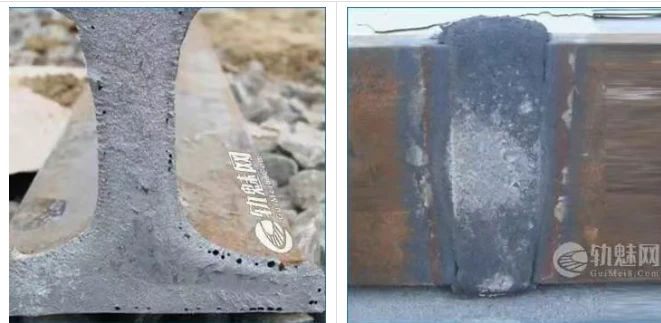
6.1 Causes of formation
(1) The end face of the rail to be welded is not thoroughly cleaned, and there is oxidised skin and other foreign matter.
(2) The preheating temperature is too low, and the aluminium-heated steel is not enough to melt the rail end.
(3) The rail seam is too small. The heat capacity of the aluminium-heated steel liquid in the weld seam is small, and it fails to melt the rail end sufficiently.
6.2 Preventive measures
(1) Thoroughly clean the two end surfaces of the rails to be welded.
(2) The preheating temperature of the rail needs to be reached, and the preheating temperature is evenly distributed.
(3) The rail seam is moderate.
7 Edge biting refers to the grooves or depressions produced along the base material part of the weld toe due to improper selection of welding parameters or incorrect operation process (see Figure 7).
Biting the edge of the often cause stress concentration, so that the rail in the dynamic load of the train, it is possible to produce cracks in the biting edge, resulting in early fatigue fracture of the rail in use.
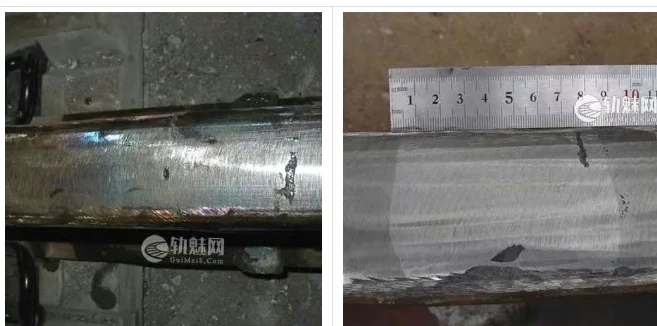
7.1 Causes of formation 1. too large rail joints. 2. welding of old and new rails. 3. excessive preheating of the rail head.
If you'd like to know more knowledage or details of railway equipment, please contact me:
Alina Shen
Jinzhou Tiegong Railway Maintenance Machinery Co.,Ltd.
E-mail: jztg0115@163.com / alina@tiegong.net
M.P/Wechat/Whatsapp:+86-18341633378
Mobile: +86-15041639960
Web: https://www.tiegongcn.com