





What exactly is the difference between 60 kg/m rails and 60 N rails?
 Jun 27, 2026|
 Why is there a push to promote 60N rails? This article provides a brief introduction, drawing on the wheel-rail contact relationship. I. What is a 60 rail? The 60 rail is one of the standard cross-section rails commonly used on China's railways, where '60' indicates that the rail weighs approximately 60 kg per metre. For a long time, 60 kg/m rails have been widely used on conventional-speed, heavy-haul and high-speed railway lines. 󠅅󠅃󠄵󠅂󠄪󠄡󠅬󠇘󠆭󠆘󠇙󠆝󠅵󠇗󠆭󠆁󠄐󠇗󠅹󠅸󠇖󠆍󠅳󠇖 󠅹󠅰󠇖󠆌󠅹The traditional 60-type rail features a mature design, a wide range of applications and extensive laying experience, and is a key standard rail type for China's railway lines. However, with increasing train speeds, rising axle loads and higher operational quality requirements for high-speed rail, the issue of compatibility between traditional 60-type rails and the treads of certain wheels has gradually come to the fore. 󠅅󠅃󠄵󠅂󠄪󠄡󠅬󠇘󠆭󠆘󠇙󠆝󠅵󠇗󠆭󠆁󠄐󠇗󠅹󠅸󠇖󠆍󠅳󠇖 󠅹󠅰󠇖󠆌󠅹In actual operation, Type 60 rails may experience issues such as the point of contact between the wheel and the smooth band being off-centre, excessive contact stress at the gauge angle, and spalling and fatigue damage at the gauge angle on curved sections. Although these issues are not entirely determined by the rail cross-section, the match between the rail profile and the wheel tread is one of the key influencing factors. 󠅅󠅃󠄵󠅂󠄪󠄡󠅬󠇘󠆭󠆘󠇙󠆝󠅵󠇗󠆭󠆁󠄐󠇗󠅹󠅸󠇖󠆍󠅳󠇖
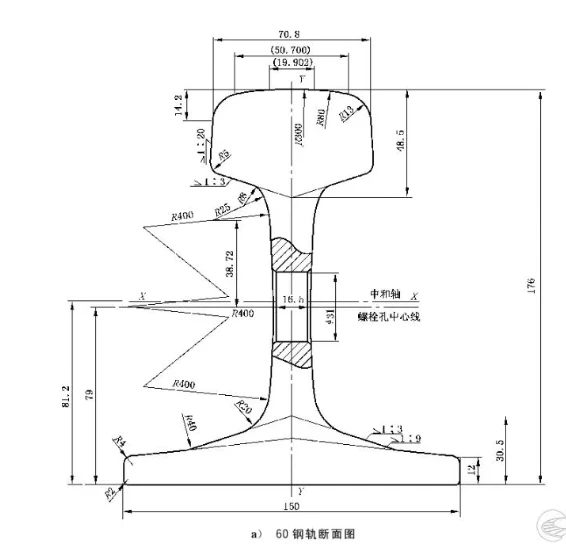
What is a 60N rail? The 60N rail is a new type of rail developed through the optimisation of the 60 rail design. It does not simply involve altering the weight of the rail, but rather optimises the rail head profile whilst minimising changes to the original rail dimensions as far as possible. The 'N' here can be understood to stand for a new type of rail with an optimised profile. The primary objective of the 60N rail is to improve the contact position between the wheel tread and the rail head, thereby optimising the wheel-rail contact patch, reducing abnormal contact in the gauge angle region, and consequently lowering contact stress and improving the service life of the rail. 󠅅󠅃󠄵󠅂󠄪󠄡󠅬󠇘󠆭󠆘󠇙󠆝󠅵󠇗󠆭󠆁󠄐󠇗󠅹󠅸󠇖󠆍󠅳󠇖 󠅹󠅰󠇖󠆌󠅹 Put simply, 60N rails do not involve 'increasing the weight' of the rails, but rather 'optimising' the profile of the rail head.
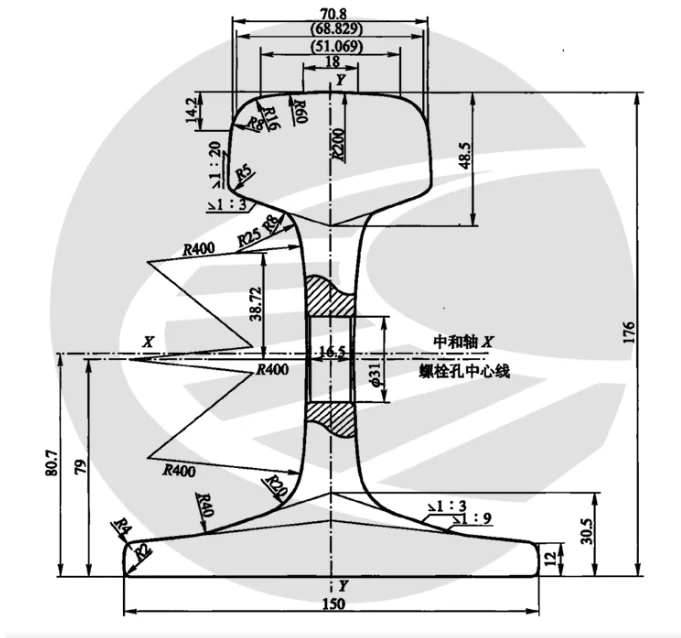
The main difference between 60 rails and 60N rails lies not in the rail base or web, but primarily in the rail head profile. The main differences are as follows:
Differences between 60 rails and 60N rails


(1) Whilst maintaining the rail crown arc width at 70.8 mm and the height at 14.2 mm, the number of segments in the rail crown arc has been increased from 5 to 7, bringing it into line with the European 60E2 rail; (2) The radii of the rail crown arcs have been adjusted to 200, 60, 16 and 8 mm respectively. The overall effect is that the rail crown within a small range is largely consistent with that of the 60 rail, whilst the profiles on either side are narrower than those of the 60 rail. The primary objective of optimising the rail crown profile of the aforementioned 60N rail is to prevent the wheel contact patch from being off-centre on straight sections, as well as to avoid gauge angle spalling and fatigue core damage on curved sections.