




What are the emergency power - supply systems in rail vehicles?
 Dec 05, 2025|
 As a trusted Rail Vehicle supplier, I've witnessed firsthand the critical importance of emergency power - supply systems in rail vehicles. These systems serve as a safety net, ensuring that trains can operate safely and effectively even when faced with unexpected power outages. In this blog, I'll delve into the various emergency power - supply systems used in rail vehicles, exploring their functions, advantages, and limitations.
1. Battery - Based Emergency Power Systems
Battery - based emergency power systems are one of the most common solutions in rail vehicles. These systems typically use lead - acid or lithium - ion batteries to store electrical energy.
Lead - Acid Batteries
Lead - acid batteries have been used in the railway industry for decades. They are relatively inexpensive and have a well - established technology. In a rail vehicle, lead - acid batteries can provide power for essential functions such as lighting, control systems, and emergency braking in case of a main power failure.

However, lead - acid batteries also have some drawbacks. They have a relatively low energy density, which means they need to be large and heavy to store a significant amount of energy. Additionally, their lifespan is limited, and they require regular maintenance, including checking the electrolyte levels and ensuring proper charging.
Lithium - Ion Batteries
Lithium - ion batteries are becoming increasingly popular in rail vehicles due to their high energy density, long lifespan, and low self - discharge rate. For example, in our Customized Rail Trolley, lithium - ion batteries can be used as an emergency power source. These batteries can provide a reliable power supply for a longer period compared to lead - acid batteries, and they are more compact, which is beneficial for space - constrained rail vehicles.
The use of lithium - ion batteries in rail vehicles also reduces the overall weight of the vehicle, improving energy efficiency. However, they are more expensive than lead - acid batteries, and proper thermal management is required to ensure their safety and performance.
2. Diesel - Generator Sets
Diesel - generator sets are another common emergency power - supply option for rail vehicles. These systems consist of a diesel engine coupled to an electrical generator.
Function and Advantages
When the main power supply fails, the diesel - generator set can be automatically or manually started to provide electrical power to the vehicle. Diesel - generator sets can generate a large amount of power, which is suitable for powering not only essential systems but also some non - essential systems if necessary. They are also relatively independent of the external power grid, making them a reliable option in remote areas or during widespread power outages.
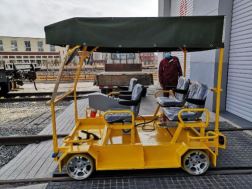
For instance, in our Transporting Tool Lithium Battery Rail Trolley 4 seats special designed Inspection vehicle, a diesel - generator set can be installed as a backup power source. This ensures that the vehicle can continue its inspection tasks even when there is a power failure on the rail line.
Limitations
However, diesel - generator sets have some disadvantages. They produce noise and emissions, which can be a concern in urban areas or environmentally sensitive regions. Additionally, they require regular maintenance, including oil changes, filter replacements, and engine tune - ups. The fuel storage and handling also pose some safety risks.
3. Supercapacitors
Supercapacitors, also known as ultracapacitors, are a relatively new technology in the field of emergency power - supply systems for rail vehicles.
How They Work
Supercapacitors store energy electrostatically rather than chemically like batteries. They can charge and discharge very quickly, which makes them suitable for providing short - term high - power bursts. In a rail vehicle, supercapacitors can be used to provide power for functions such as starting the main power system after a power outage or for emergency acceleration in case of a critical situation.
Advantages and Limitations
One of the main advantages of supercapacitors is their long cycle life. They can withstand hundreds of thousands of charge - discharge cycles, which is much higher than that of batteries. They also have a high power density, allowing them to deliver a large amount of power in a short time.
However, supercapacitors have a relatively low energy density compared to batteries. This means that they can only store a limited amount of energy, and they are not suitable for providing long - term power supply.
4. Fuel Cells
Fuel cells are an emerging technology for emergency power - supply systems in rail vehicles.
Principle of Operation
Fuel cells generate electricity through an electrochemical reaction between a fuel (usually hydrogen) and an oxidant (usually oxygen from the air). In a rail vehicle, fuel cells can provide a clean and efficient power source.
Benefits and Challenges
The main benefit of fuel cells is that they produce zero emissions during operation, which is environmentally friendly. They also have a high energy conversion efficiency, which can reduce the overall energy consumption of the rail vehicle.
However, the use of fuel cells in rail vehicles faces some challenges. The infrastructure for hydrogen production, storage, and distribution is not well - developed, which limits their widespread adoption. Additionally, fuel cells are relatively expensive, and their durability and reliability need to be further improved.
5. Hybrid Emergency Power Systems
To take advantage of the strengths of different power - supply technologies, many rail vehicles now use hybrid emergency power systems.
Combining Technologies
For example, a hybrid system may combine a battery - based system with a diesel - generator set. The battery can provide immediate power during a power outage, while the diesel - generator set can be started later to provide long - term power if needed. This combination can improve the overall reliability and performance of the emergency power - supply system.
In our Ballast bed Cleaning Automatic Hydraulic Ballast Cleaner remote control, a hybrid emergency power system can be designed to ensure continuous operation during power failures. The battery can power the control systems and some low - power components immediately, and the diesel - generator set can then take over to power the hydraulic system for the ballast cleaning operation.
Conclusion
In conclusion, there are several emergency power - supply systems available for rail vehicles, each with its own advantages and limitations. As a Rail Vehicle supplier, we understand the importance of selecting the right emergency power - supply system based on the specific requirements of the vehicle, such as the power demand, operating environment, and budget.
Whether you need a reliable battery - based system, a powerful diesel - generator set, or an innovative hybrid solution, we can provide customized options to meet your needs. If you are interested in our rail vehicles and their emergency power - supply systems, please feel free to contact us for procurement and further discussion. We look forward to working with you to ensure the safety and efficiency of your rail operations.
References
- Railway Electrification Handbook, Second Edition, by John Fletcher
- Handbook of Batteries, Fourth Edition, by David Linden and Thomas B. Reddy
- Fuel Cell Systems Explained, Second Edition, by Jeremy P. Meyers, Elton J. Cairns, and Richard E. White