





Maintenance of Crossover and Compound Switches
 Aug 09, 2024|
 What kind of turnout is a compound crossing turnout?
The compound crossing turnout is like an X shape, which is actually equivalent to a combination of four sets of single turnouts and a diamond cross. The compound crossing turnout is composed of a turnout incorporated into another turnout, and is generally used to connect several parallel lines. It is a good equipment that can shorten the throat length of the station, reduce the land used for vehicles, and improve the efficiency of shunting operations. It can play the role of two single turnouts.
According to the structural form of its obtuse frog, the compound crossing turnout can be divided into fixed obtuse frog and movable heart rail type obtuse frog. The characteristic of the movable heart rail type obtuse frog is that it eliminates the long harmful space of the obtuse frog, which can extend the service life of the equipment and ensure stable driving.
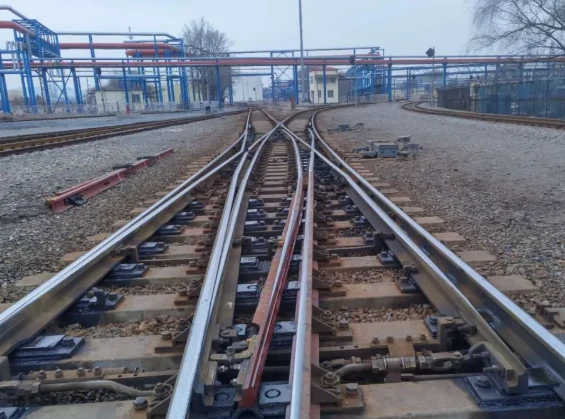
What kind of turnout is called a crossover?
The combination of connection and crossing in turnouts includes crossing turnouts and crossovers. If the upper two points and the lower two points of the X-shaped compound crossing turnout are connected respectively, it is a crossover. It can not only open more directions, but also does not occupy much space, so it is often used in stations.
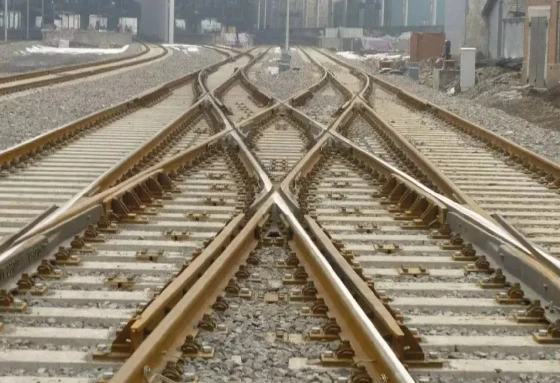
How to maintain the compound crossing turnout on a daily basis?
Although laying a compound crossing turnout can reduce the number of single turnouts and reduce the area occupied by the station, its structure is complex, with many passages, and the rails are mutually restricted, and the technical requirements for the dimensions of each part are high. There are special requirements for the maintenance of the gauge reduction of each part of the blunt-angle turnout. If it is not properly maintained, it is difficult to keep it in good condition. In the maintenance and repair of the compound crossing turnout, you must first be familiar with the equipment, understand the dimensions of each part, check frequently, analyze carefully, and then take effective measures to carry out the operation.
(1) Track raising
When the station is generally flat and the track raising amount of the turnout is small, generally find a higher point as the control point, and then level the blunt-angle turnout according to the control point, and then check the track raising at both ends. When the station is not generally flat and the track raising amount is large, it can be raised from one end to the other. It is necessary to prevent the track raising amount from being too high at one time, causing "floating". When raising the level, the two middle rails (or the apex of the two bent basic rails) should be used as the reference to raise the turnout comprehensively. Prevent one track from having a large superelevation while the other track has a reverse superelevation.
Strengthen the tamping of key locations such as the tip, heel and sharp-angle frog fork to prevent the damage and reverse superelevation of the track caused by low joints and low frog fork. Each track within the range of the point rail should be tamped to prevent the occurrence of empty hangers. If necessary, a small ballast can be strung with a pestle and a pick.
(2) Track shifting
First, straighten the intersection of the two main driving directions and the general direction of the line connecting the two ends, align the frogs, and then pull the string (long axis) from the tips of the two sharp-angle frog heart rails to check and verify the guide curve support distance. For over-limit locations, correct them before changing the track.
(3) Track change
First, change the gauge of the intersection straight line, then use the outer strand of the guide curve as the reference, change the inner strand of the curve, and then check and correct the intervals of each part. When the basic rail is insufficiently bent or worn, it should be repaired in time.
(4) Preventing electrical connection
Most crossing turnouts are laid in the station yard. During operation, attention must be paid to the influence of electrical connection on signal display. According to actual requirements, insulating pads, inclined slide plates and short slide plates should be installed at the tips of the two curved point rails. During operation, materials should not be placed between the two curved point rails to prevent electrical connection. When starting the track, it is necessary to prevent the point rail tie rod and connecting rod from connecting with the bottom of the steel rail above them. At the same time, the tamping of this part should be strengthened to prevent the point rail or base rail from jumping or sinking when passing the train, thereby causing electrical connection. Be familiar with the track circuit layout and strictly abide by the relevant regulations on track circuit turnout operation.
(5) Preventing 4mm blocking defects
1) For crossing turnouts and their front and rear lines, the large flat plate should be started, the direction should be straightened, the unqualified track gauge and interval between each part should be corrected, the heart rail should be straightened, the base rail with a sagittal that does not meet the requirements should be bent, and the fat edges of the point rail and base rail should be polished to keep them close.
2) Add special gauge rods, rail supports and anti-lateral movement baffles to strengthen the lateral stiffness at the center axis and within the range of the point rail, prevent the basic rail from moving laterally, maintain a fixed spacing, and repair, repair or replace failed parts.
3) Strengthen the anti-climbing locking of the turnout and the front and rear lines. In addition to using observation piles for inspection, the structural characteristics of the turnout itself can also be used for inspection. For example, the tip of the point rail should adopt the "four points and one line", and the heel of the point rail should adopt the "four seams and one line" method.
(6) Mutual coordination between the work area and the signal
Any operation involving signal equipment must be carried out with the cooperation of signal professionals.
How are crossovers maintained on a daily basis?
Crossovers occupy a large area. In addition to the four sets of single turnouts, which have the same maintenance rules as general turnouts, the structure of the cross section is complex, the rails are staggered, the turnout sleepers are connected, and the gauge, level, and direction are intertwined. Therefore, the track raising, track shifting, and track changing must be appropriate and the procedures must be reasonable, otherwise it is difficult to keep it in good condition all the time.
1. Track raising
When the station yard is relatively flat or the turnout is at a high place, the middle part (including the cross part and the ordinary frog part of the four corners) should be raised first, and then the four corners should be raised, so that the entire turnout can be raised easily. When raising the middle part, first find the high and low and the higher level as the control point, raise the level of each rail, and then use this as a standard to raise the middle part, and then raise the four corners separately. If the turnout is located at the low point of the station yard, in the case of a large amount of track raising, one corner can be selected to introduce it into the station yard, and then the track raising work can be done according to the procedure of raising the middle first and then the other three corners. The crossing section of the turnout consists of 8 short rails, and the short rails often arch over the waist, which often causes horizontal overruns. The long turnout sleeper at the joint causes the head to warp, which is also one of the reasons for the arch of the short rail. Due to the uneven traffic density in each direction, the bottom of the rail with fewer vehicles passing through forms a gap with the pad or turnout sleeper, resulting in an empty hanging plate. This is an unfavorable factor that hinders the height and level. Special attention should be paid when starting the track to ensure the quality of the track. If there are many vehicles passing through the crossing section, the acute angle frog and the obtuse angle frog are easy to fall down, so they can be raised appropriately; if there are few vehicles passing through the crossing section, it is forbidden to raise them, so as not to form a "pagoda" shape with low sides and high middle. During maintenance, in order to make it smooth with the middle, it is necessary to raise the four corners, which will be raised higher and higher, which is not conducive to the overall leveling of the station.
2. Track shifting
(1) First, align the two single-opening turnouts on one side with the general direction of the line. In particular, the turnout tail joint and the guardrail part of the single-opening turnout on this side should be strictly aligned with the general direction of the line. The misalignment of this direction will directly affect the track shifting quality of the middle crossing part.
(2) When switching the two sets of single turnouts on the other side, first check the track gauges of each track at the turnout tail joints at both ends, calculate whether the turnout tail joints of the outer track on this side need to be retracted or extended, and then switch the track according to the retracted or extended values to prevent rework due to poor track gauge after switching.
(3) When switching the middle part, do not look at the straight tracks on both sides, but use the middle intersection as the reference and be straight with the front and rear directions, because the acute angle frogs and the outer two tracks of the intersection are fixed on the same spliced turnout sleeper, changing the intersection is complicated, and changing the outer line is easy.
3. Track change
(1) First, change the track gauges of the four sets of ordinary frogs at the two ends of the single turnouts, and place the ordinary frogs in the correct position, because the correctness of the track gauge and frog position in this part will affect the track reading of the intersection.
(2) When changing the track gauge of the intersection, check the track repeatedly from four angles to make the positions of the acute angle frogs and obtuse angle frogs appropriate in both directions.
(3) At the intersection, especially the blunt-angle frog section, the rerouting should take into account the relationship between the track gauge, wheel flange groove, inspection interval and back guard distance. If the wheel flange groove size exceeds the specified limit, it should be repaired before rerouting.
4. Causes and prevention of blunt-angle frog tip collision disease
The commonly used No. 9 and No. 12 crossing crossovers use No. 4, 5 and 6 blunt-angle frogs. The frog heart rail tip is easily hit by the wheel, even endangering driving safety.
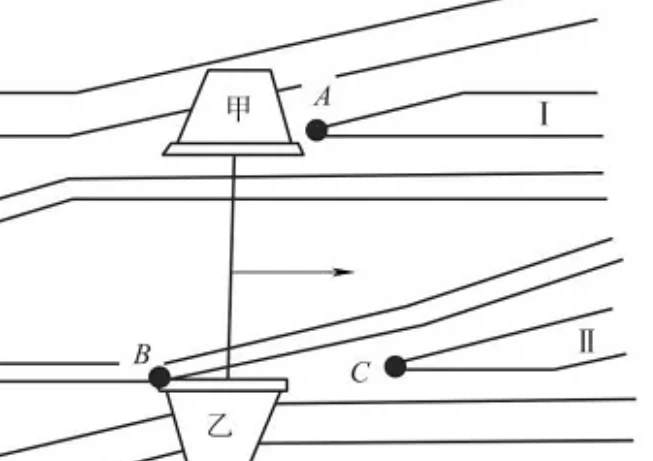
As shown in the figure, when the wheel leaves point B and enters the harmful space, its wheel flange is no longer controlled by the guardrail. Under the action of lateral force, there is a gap of 1 to 23 mm between the front side of the wheel flange on one side of wheel A and the working edge of the frog center. The wheelset will move toward wheel A, resulting in the phenomenon of the wheel flange hitting the frog center at point A or point C.
There are four measures to prevent the wheel flange from hitting the fork center:
(1) The relative position of the two blunt-angle frogs must always be kept straight. If there is any misalignment or creeping, they should be locked in time.
(2) The bend of the guardrail must always be kept sharp and angular, and the guardrail length should not be shortened due to rounding of the edges. The worn and smooth bends should be welded, and attention should be paid to keeping the bends on the same vertical plane when welding.
(3) Before replacing blunt-angle frogs, check whether the guardrail line and the non-working edge of the heart rail are in a straight line. If they are not in the same straight line, they should be straightened before use. Obtuse-angle frogs on the line can be solved by grinding or welding.
(4) For frogs where the top surface of the guardrail is not raised or is not raised enough, the guardrail can be raised to 22mm (maximum not more than 25mm) to increase the distance between the guardrail and the wheel back.