





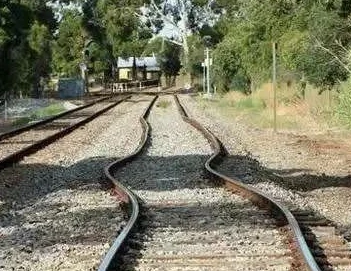
Why do railway tracks twist and turn in hot conditions
 Jun 30, 2023|
 When the rail is free, it will expand and contract when the temperature changes. In summer it lengthens when it is hot, in winter it shortens when it is cold, i.e. "thermal expansion and contraction". When multiple rails are joined together to form a track, there will obviously be a joint every 12.5m or 25m. The gap between the joints is approximately 8 mm and is designed to prevent the rail from being damaged by the temperature forces that occur during thermal expansion and contraction. In general, for every 1°C change in rail temperature, each rail is subjected to a pressure or tension of 1.645 tonnes. For a 50°C change in rail temperature, a rail is subjected to a pressure or tension of up to 82.25 tonnes. Such a huge temperature force is enough to disrupt the normal condition of a railway track turnout. Therefore such a large expansion and contraction on a seamless line is never allowed and anti-climbing equipment must be used to lock the two ends, or a strong line resistance is set up in the line track to lock the track in order to limit the free expansion and contraction of the rails.
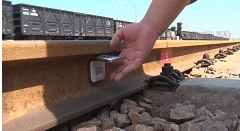
If a certain length range of rail ends fixed, limit the free expansion of the rail, the rail temperature change, the line rail will appear internal stress, this force is caused by the rail temperature change, so called temperature force. Specifically that is seamless line by lock, summer temperature rise, the rail by heat elongation, but by restraint can not elongate, internal compressive stress; winter temperature decrease, the rail by cold shorten, but by restraint also can not shorten, internal tension. Because the rail is so firmly locked in the rail sleeper, the rail can be subject to such a large temperature force without deformation, which is the basic principle of the seamless line.
When the rail temperature is higher than the locked rail temperature, the rail section of the seamless line is subjected to temperature pressure. The temperature pressure is proportional to the number of degrees of positive change in rail temperature. When the rail temperature rises to the maximum value maxt, the temperature pressure reaches the maximum value maxPt.
On the other hand, because of the joint resistance and the longitudinal resistance of the rail bed, the majority of the temperature pressure is confined to the rail section and only a very small part is released in the expansion zone. This temperature pressure, which is confined to the rail section, has to be released according to the laws of nature in order to achieve a complete balance. When it reaches a certain value, still can not find a way out in the longitudinal direction, it will go to the transverse direction to find a way out, and the curve of the seamless line provides it with this opportunity, that is, the longitudinal temperature pressure synthesis of the radial force Pr just point to the direction of the outside of the curve, so that the curve follows the trend of the upward strand direction dropsy. And straight lines can not be absolutely straight, once some bend somewhere, the longitudinal temperature pressure will also be bent in the direction of the synthesis of radial component force Pr, resulting in the direction of straight track bending deformation.
In this way, as long as the temperature pressure reaches a certain value, the seamless line track appears transverse deformation is inevitable.
A large number of tests show that this deformation of the occurrence and development process is a certain law, basically can be divided into three stages: holding stable stage, expansion of the track stage and runway stage.
(A) hold stable stage
The stable stage is the initial stage of the seamless line to withstand the temperature pressure. In this stage, although the temperature pressure because of the rail temperature increases, but the track does not deformation, still maintain the initial state, temperature force completely to the elastic state "storage" in the rail section. The smaller the initial bending of the rail, the higher the value of the temperature pressure corresponding to this state. If the rail is ideally geometrically straight, this state may continue until the temperature pressure reaches a considerable value before the sudden dropsy occurs under the disturbance of external forces; however, for various reasons, the rail cannot be ideally geometrically straight, there will always be some degree of bending; therefore, the temperature pressure of the rail during the stabilisation phase cannot reach the aforementioned "considerable value "On the contrary, the lower the resistance of the line and the worse the track geometry, especially in terms of direction, the lower the temperature pressure causing dropsical deformation of the track.
Whether the track of a seamless line is "stable" depends on whether the temperature pressure has reached a critical value, i.e. whether the track temperature has reached a critical track temperature. The critical temperature pressure or critical rail temperature varies with the state of the line and can be high or low. For the same seamless line, as long as the temperature exceeds the critical value, the track goes from a stable state to an expanded state.
The temperature pressure at which the seamless line enters the expanded rail state from a stable state is called the first critical temperature pressure. During the holding phase, the seamless line is relatively safe.
(ii) Expansion of the rail phase
When the rail temperature continues to rise and the temperature pressure crosses the first critical value, the expansion phase begins. During this phase, the increasing temperature pressure causes a small to large, small to large lateral deformation of the track, sometimes clearly perceptible to the naked eye - the bending lines become more and more pronounced, the deformation vectors become larger and the track orientation significantly worse.
But the track temperature cannot rise indefinitely. When it reaches a certain level (as long as it is within the tolerance of the track) and then starts to fall, as the temperature pressure is gradually lifted, it is possible to see that the deformation and bending of the track is reduced until it returns to its initial state. In other words, during the expansion phase, the deformation of the track is an elastic deformation.
The elastic deformation of a seamless line track under temperature pressure is called expansion of the track.
In the expansion phase, after the temperature pressure is lifted, the elastic deformation of the track can be restored to its initial state of only 2 mm. theoretically, the elastic deformation of the track over 2 mm cannot be fully restored after the temperature pressure is lifted, and some residual deformation must be left. The track temperature changes repeatedly, this residual deformation will accumulate to cause serious bad direction. Therefore, the amount of track expansion must be limited in time.
(C) runway stage
In the track expansion phase, the temperature pressure does not exceed the capacity of the seamless line, but it is possible to reach the limit of the capacity. At this point, the relative stability of the seamless line is barely being maintained and safety is at risk.
When the track temperature rises slightly again, the temperature pressure continues to increase; if the track is slightly disturbed by external forces (such as train braking, construction influence, hammering rails, etc.), the excessive temperature pressure accumulated on the rail section will track geometry suddenly undergo malignant changes - the deformation vector of the expansion stage suddenly increases significantly, sometimes up to hundreds of millimetres, the track in A moment to make a huge sound serious dropsy, rail row out of and pull rotten bed, or rail and rail sleeper detachment lead to the complete loss of driving conditions. Through the serious distortion deformation of the rail can be seen, its deformation has exceeded its elastic limit, become plastic deformation; rail section on the temperature force has been all released; rail in the natural state in the "zero stress" state, temperature pressure and line resistance eliminated at the same time, when the line has been seriously damaged.
Seamless line rail in the temperature pressure under the role of destructive deformation called runway.