The History of Rail Bolt Wrench
 Apr 18, 2022|
 The History of Rail Bolt Wrench
The bolt wrench is an important working tool for railway rail laying construction and track maintenance. At present, there are mainly the following types of bolt wrench machines used by railway public works departments:
1. Single socket mechanical impact wrench. The structural wrench adopts the mode of small power mechanical impact to realize large torque output, and the fastening bolts on both sides of the rail are respectively tightened. The main shortcomings of the structural wrench are: first, it is difficult to accurately control the tightening torque and the fastener pressure is uneven; The second is that the tightening torque cannot be adjusted or accurately adjusted; Third, when the left and right transposition operation, it is necessary to raise the working head, and the labor intensity of the operator is high; Fourth, the two sides cannot be tightened at the same time, resulting in eccentric load on the rail; Fifth, the rotating speed is high, the nut is seriously damaged, and the failure rate of the machine itself is high.
2. Mechanical gasoline powered stud wrench. The structural feature of the structural bolt wrench is that it is equipped with two wrench operating mechanisms, which can tighten or loosen the fastening bolts on both sides of the rail at the same time. Therefore, compared with the single head mechanical impact wrench, the working efficiency is higher, the accuracy is also improved, and the operation is simple. However, there are still some obvious deficiencies in the structural bolt wrench. First, it is difficult to accurately control and stabilize the torque, the maximum tightening force is small, and the torque will gradually decrease with the use time, and the user cannot know; The second is that the bolts on both sides cannot reach the required tightening value at the same time, resulting in eccentric load on the rail; Third, because the center distance between the working heads of the two operating mechanisms of the wrench cannot be adjusted and the torque cannot meet the requirements of bolts of different types of fastening systems, the operation can only be carried out on the bolts of the same type of fastening system, that is, it can only be applied to the same type of fastening system with the same bolt spacing, and the scope of application of the operation is narrow.
3. Hydraulic rail bolt wrench. The prior art hydraulic rail bolt wrench has double head and single head structures. This kind of wrench adopts the method of pressure and torque conversion to determine the output torque of the control wrench, which belongs to static torque. Therefore, the output torque of hydraulic bolt wrench is more accurate and stable than that of mechanical bolt wrench. However, the hydraulic bolt wrench of the prior art also has some shortcomings. First, the double headed hydraulic bolt wrench of the prior art is not a double headed bolt wrench in the real sense, which belongs to "false double headed", that is, in a machine, it can’t realize the working conditions of double headed tightening and double headed loosening at the same time, but can only realize one of the working conditions of double headed tightening or double headed loosening. Second, the torque value of the existing hydraulic bolt wrenches is converted by hydraulic pressure, and the torque value is affected by hydraulic pressure fluctuation, different mechanical efficiency of the motor and oil temperature. In addition, the torque reading is rough, so the accuracy of the wrench output torque is not high. Third, because the center distance between the working heads of the two operating mechanisms of the wrench cannot be adjusted and the torque cannot meet the requirements of bolts of different types of fastening systems, it can only be applied to the bolt screwing operation of the corresponding types of fastening systems, and the scope of application of the operation is narrow. In addition to the above shortcomings, the single head hydraulic bolt wrench can’t be tightened on both sides at the same time, resulting in eccentric load on the rail. When changing sides from left to right, the operator needs to raise the working head, which has the disadvantages of high labor intensity and so on. Fourth, the power system and the working system are set on the same frame, which is an overall structure. The machine is heavy, so it is very inconvenient to avoid the carrying labor intensity of operators on and off the train.
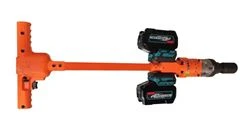
The LLB-200 battery rail bolt wrench produced by our company adopts imported batteries and components, with small volume, light weight, strong mobility, portable and convenient access. It is especially suitable for regional road maintenance of track bed that cannot be operated by large and medium-sized road maintenance machinery such as turnout, tunnel, bridge and culvert.
For more detailed information, please visit the website of our company www.tiegongcn.com or email to jztg02@vip.163.com