Structural design of seamless turnout
 Feb 10, 2023|
 The jointless turnout is an important part of the cross-section jointless track. It bears the function of the temperature force of the jointless track as the long rail. The rail in the turnout not only bears huge thermal force, but also has different stress conditions at both ends of the inner rail line. This unbalanced thermal force state is the change of the stress and deformation displacement of the rail in the seamless turnout, and is the core problem that needs to be dealt with in the design, laying, maintenance and maintenance of the seamless turnout.
Structural characteristics of seamless turnout
The design of work-electricity coordination is a very important link in the structural design of seamless turnout. On the one hand, the signaling system should ensure the normal switch switching and locking functions, on the other hand, it should be convenient to adapt to the free expansion and contraction of switch rail and point rail in the jointless track, and maintain the normal working line of switch rail and point rail after conversion;
On the one hand, the public works system provides a good working environment and installation platform for the public works system, on the other hand, it also needs to cooperate with the public works system in the structural design to overcome the insufficient displacement of the switch rail and the center rail in the conversion process, shorten the expansion displacement of the switch rail and the center rail in the jointless track as far as possible, and avoid the conversion failure beyond the allowable value of the public works system, commonly known as "jamming"
6.1.1
Basic requirements for seamless turnout structure
In addition to bearing all kinds of east-west loads of locomotives and vehicles like ordinary turnout, seamless turnout also bears huge temperature force. Therefore, the turnout structure prepared for welding and laying into seamless turnout should have certain basic conditions and meet the necessary structural requirements.
(1) Both ends of the turnout must be weldable and can be welded together with the long rail of the jointless track using the mastered welding technology. When necessary, the two ends of the turnout can also be connected with the long rail by "freezing" or bonding.
(2) The turnout rail fastener must adopt strong elastic fastener to make the pushing resistance of the fastener greater than the longitudinal resistance of the track bed in the turnout area. When the gusset plate fastener is used, the anti-creep locking of the inner rail of the turnout should be strengthened. It is better to use the spring bar fastener. The fastener bolt should be tightened according to the specified torque.
(3) The switch rail and the heel end of the center rail of the turnout must be installed with force transmission components such as spacers or limiters to realize the longitudinal force transmission between the two rails. The connecting bolts of the force transmission components should be high-strength bolts to increase their friction resistance and shear resistance of the bolts, and should be tightened with the specified torque torque.
(4) The turnout sleepers of seamless turnout shall have sufficient transverse bending rigidity. Reinforced concrete turnout sleepers with type II or type III elastic fasteners can fully play the role of concrete turnout sleepers in increasing rail longitudinal force resistance.
(5) The track bed in the turnout area shall be full and dense. Special attention shall be paid to filling and tamping the ballast in the turnout sleeper box, and the ballast shoulder shall be widened according to the requirements of jointless track.
(6) Equipment such as switch switching, locking and sealing inspection must adapt to the large expansion displacement of switch rail and center rail, and shall not cause conversion failure due to the expansion of switch rail.
(7) The design of all parts and components in the turnout, including the setting of bolt holes, should take into account the impact of rail expansion and contraction to avoid problems such as bolt hole dislocation and parts collision.
Transmission way of temperature force of seamless turnout
After taking out the isolation body of the seamless turnout (all the straight side strands are welded) from the seamless track, the transfer path of the temperature force in the turnout is shown in the figure. It can be seen that the temperature force of the long and short center rails behind the turnout is transferred to the wing rail and guide rail (i.e. the guide rail connecting the straight switch rail) through the frog heel structure, and to the stock rail through the switch heel structure; During the expansion and contraction of the guide rail, it also drives the turnout sleeper to move longitudinally, and transmits part of the temperature force to the stock rail. It can be seen that the design of the force transfer structure in the turnout is one of the key technologies to ensure that the stress and deformation of the jointless turnout are reasonable and to realize the jointless track in Kua section.
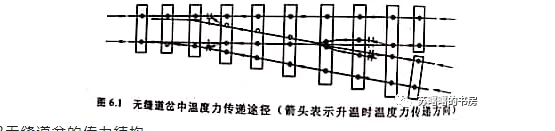
Force transmission function of fastener
The fastener is an important component in the jointless track. In the ordinary jointless track, its longitudinal resistance is required to be greater than the longitudinal resistance of the track bed. The relative displacement of the rail and the sleeper is controlled to ensure the maximum line resistance. In the seamless turnout, the resistance of the fastener is also required to be as large as possible to ensure that the larger temperature force of the inner rail is transferred to the turnout sleeper and then to the stock rail. The longitudinal resistance of the fastener on the two inner rails is equal to the sum of the longitudinal force of the track bed of the turnout sleeper and the longitudinal resistance on the two stock rails. Therefore, the inner direction of the inner rail fastener is opposite to the longitudinal resistance direction of the stock rail, and the corresponding temperature force gradient is also opposite.
Force transfer function of turnout sleeper
After bearing the longitudinal force transmitted by the inner rail fastener, the turnout sleeper will move longitudinally, offset and even bend transversely, and then the stock rail will also move through the fastener resistance, so as to realize the transfer of temperature force from the inner rail to the stock rail. The more dense the ballast track bed is, the larger the cross section area of the turnout sleeper is, and the greater the longitudinal resistance of the track bed is. Therefore, the smaller the longitudinal resistance of the stock rail fastener is, the smaller the stress and deformation of the stock rail is.
If you want to know more details, please contact me!