Technical requirements for rail grinding
 Mar 04, 2024|
 1. Rail grinding target profile.
1. Straight lines and large-radius curved sections generally adopt a 60N profile (as shown in Figure).
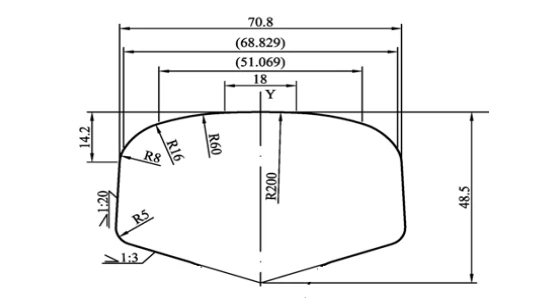
2. For sections where the curve radius of lines with a design speed of 350km/h is less than or equal to 7000m, sections where the curve radius of lines with a design speed of 300km/h is less than or equal to 5000m, and sections where the curve radius of lines with a design speed of 250km/h and below is less than or equal to 3500m, the 60N profile can be used shape or individually design and polish the profile according to the wheel-rail matching relationship.
3. Repair grinding of rails should first eliminate defects and at the same time correct the profile of the rail head.
4. The rails should be ground strictly according to the target profile, and the rail polishing target profiles on the same line (except for individual design sections) should be consistent.
2. The rail grinding depth should meet the following requirements:
1. Pre-grinding: The minimum grinding depth of the central area of the rail top (-1°~+3°, as shown in Figure 5.2.4-2) is not less than 0.2mm. Among them, turnout grinding is mainly to ensure the rail head profile, and the grinding depth can be appropriately reduced.
Note: The inner line is 60N profile, the outer line is 60 rail head profile
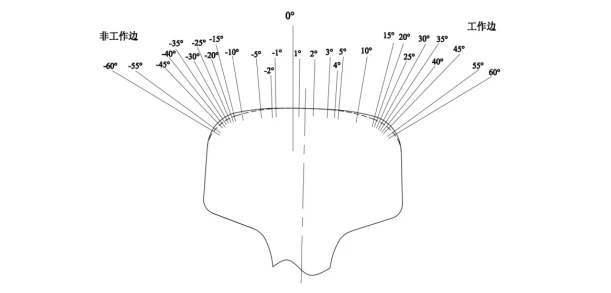
Figure Comparison of 60N profile and 60 rail head profile
2. Preventive grinding: the central area of the rail top should not be less than 0.1mm.
3. Repair grinding: After the rail is modified, it reaches the target profile; after grinding, the corrugated rail meets the acceptance standards; after grinding, the hardness of the rail surface of the scratched rail should not be higher than the hardness of the adjacent base material rail surface 50HB; the fish scale pattern of the rail should be eliminated; small The grinder must not burn the rail when grinding.
3. The roughness of the grinding surface should not be greater than 10µm.
4. The maximum width of the rail grinding surface should meet the following requirements:
1. The 10mm area on both sides of the longitudinal centerline of the rail top is 10mm, the 10 to 25mm area is 7mm, and the remaining polished areas are 5mm.
2. Within a range of 100mm in the longitudinal direction of the rail, the maximum change in the width of the grinding plane should not be greater than 25% of the maximum width of the grinding plane.
3. The contact light belt of the straight and curved strand wheel rails should be basically centered and the width is 20~30mm; the contact light strip of the strand wheel rails on the curve should be biased to the inside.
5. The straightness of the base metal after grinding in the area 1 to 3 meters away from the welding joint should be controlled at -0.1 to +0.3mm/1m.
6. After grinding, the rails should have no fat edges, no fatigue cracks, and no continuous blue bands.
If you want to get more informations, please contact me!